
.png)
Navigating Supply Volatility (Nothing / CMF)
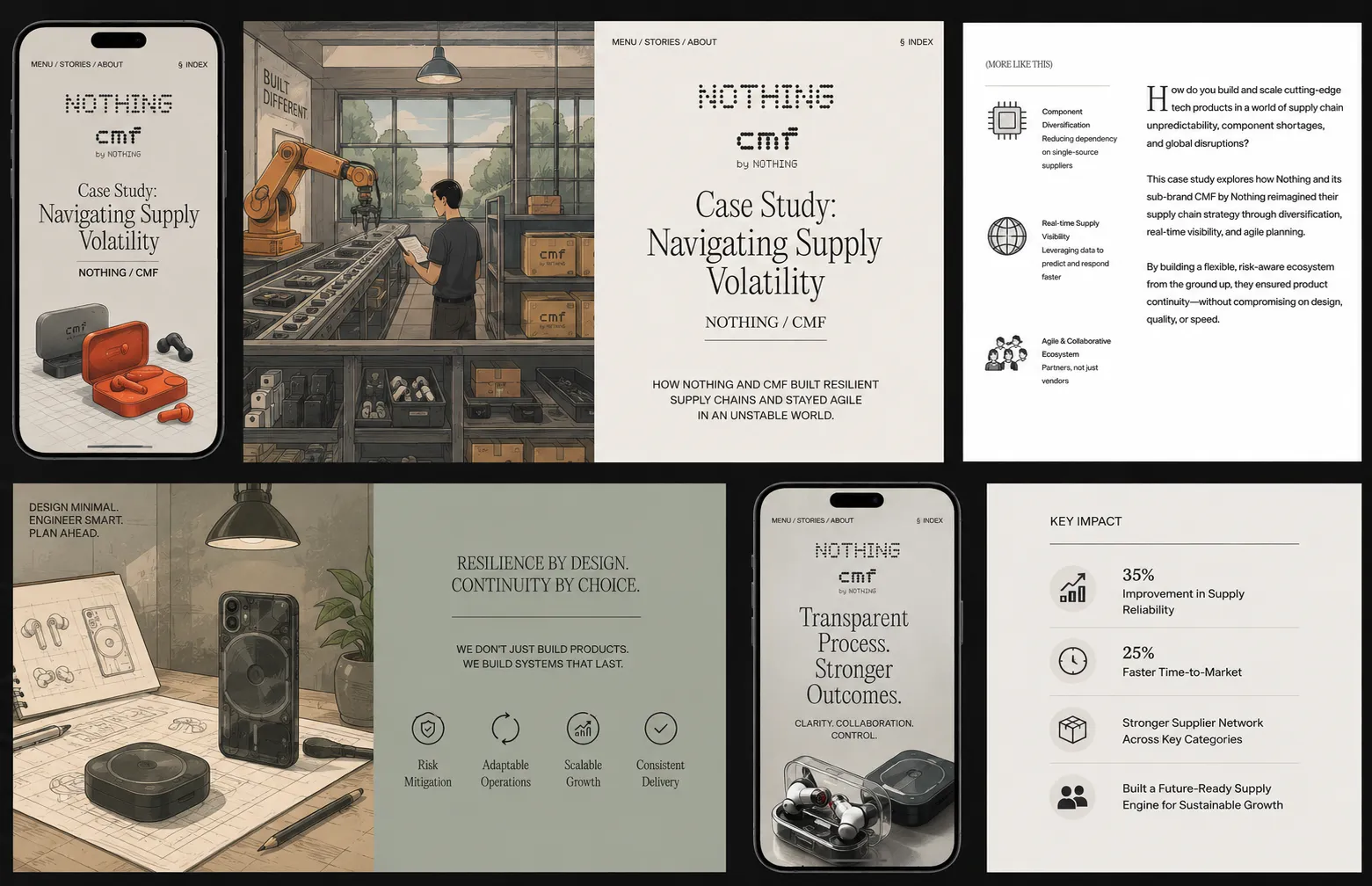
Navigating Supply Volatility & Hardware Constraints: Lessons from Nothing's CMF Cancellation
On June 19, 2026, Nothing cancelled the CMF Phone 3 Pro not because demand disappeared or the product lacked innovation, but because its supply chain economics no longer worked. The rapid growth of AI infrastructure dramatically increased demand for DRAM and NAND memory, sending component prices to historic highs and exposing the vulnerability of budget hardware manufacturers.
This case study explores the business decisions behind the cancellation, why smaller OEMs were affected more severely than industry giants, and how a real-time component telemetry platform could provide earlier signals for procurement and product planning.
TL;DR
- Company: CMF by Nothing, known for delivering premium design at budget-friendly prices.
- Challenge: AI-driven demand for memory chips caused DRAM prices to surge, dramatically increasing smartphone production costs.
- Impact: Memory became one of the largest contributors to the bill of materials (BOM), making CMF's pricing model financially unsustainable.
- Result: Rather than increasing prices or reducing specifications, Nothing cancelled the CMF Phone 3 Pro.
- Technical Opportunity: A real-time BOM telemetry system could have identified procurement risks earlier, enabling better forecasting and strategic decision-making.
Understanding the Supply Chain Crisis
Unlike the semiconductor shortage during the pandemic, the 2026 memory shortage was driven by a different force: AI infrastructure.
Major memory manufacturers shifted production toward High Bandwidth Memory (HBM) used in AI accelerators for companies like NVIDIA, Microsoft, Google, Meta, and Amazon. Since manufacturing capacity is limited, every wafer allocated to AI chips reduced the supply available for consumer electronics.
For smartphone manufacturers, this translated into:
- Rapid increases in DRAM and NAND prices
- Longer procurement lead times
- Reduced availability for smaller OEMs
- Greater dependence on volatile spot-market pricing
Industry analysts expect these supply pressures to continue for several years as AI infrastructure investment accelerates.
Why CMF Was More Vulnerable
The supply shortage affected the entire smartphone industry, but not equally.
Large manufacturers such as Apple and Samsung benefit from long-term supplier agreements, purchasing power, and—in Samsung's case—vertical integration through its own memory production.
CMF operated under a different business model.
Its value proposition depended on offering flagship-inspired design at an aggressive price point with extremely tight margins. When memory costs suddenly became a much larger portion of the overall BOM, those margins disappeared almost overnight.
Instead of releasing a compromised product or significantly increasing the retail price, Nothing chose to cancel the device entirely.
Reading Between the Lines
The cancellation announcement also hinted at CMF's broader strategy.
Rather than exiting hardware, the company indicated plans to expand into new product categories such as wearables, accessories, and IoT devices.
This shift makes strategic sense.
Products like smartwatches and earbuds rely far less on high-end memory components than smartphones, making them considerably less vulnerable to ongoing DRAM shortages.
Viewed from a supply chain perspective, the move represents a portfolio adjustment toward categories with lower component risk rather than a retreat from hardware innovation.
The Engineering Challenge
While no software platform can prevent a global supply shortage, engineering teams can significantly improve how early they detect risk.
Many procurement decisions are still reactive—cost increases become visible only when suppliers issue updated quotations.
A modern engineering platform should instead monitor component markets continuously and provide early warnings before margins become unsustainable.
Core Features
Live Component Tracking
Collect pricing information every 6–24 hours for critical components including:
- LPDDR memory
- NAND storage
- SoCs
- Display panels
- Camera sensors
This creates historical pricing trends rather than isolated snapshots.
Intelligent Threshold Alerts
Instead of notifying teams whenever prices rise slightly, alerts should trigger only when a component threatens predefined margin targets.
Examples include:
- Memory exceeds 40% of BOM
- Project margin drops below target
- Supplier lead time exceeds acceptable limits
These alerts become procurement decisions rather than informational noise.
Procurement Scenario Modeling
Once an alert is generated, procurement teams should immediately evaluate scenarios such as:
- Purchase immediately
- Wait 30 days
- Lock a long-term contract
- Redesign the product around alternative components
Providing cost projections makes financial trade-offs much easier to evaluate.
Environmental Telemetry
For hardware testing environments, sensor data such as temperature, humidity, and component stress can be integrated into the same dashboard, helping engineering teams identify potential reliability issues alongside procurement risks.
Why This System Matters
The objective isn't to eliminate supply-chain volatility.
Instead, it shifts decision-making from reactive to predictive.
By identifying trends weeks before they affect production, engineering, procurement, and finance teams gain valuable time to:
- negotiate supplier contracts,
- redesign products,
- secure inventory earlier,
- adjust pricing strategies,
- or pivot product roadmaps.
Earlier visibility often determines whether a company ships a product successfully or cancels it entirely.
Key Takeaways
The cancellation of the CMF Phone 3 Pro highlights how modern hardware companies are increasingly influenced by global infrastructure trends beyond their direct control.
As AI demand reshapes semiconductor manufacturing, organizations need better visibility into component availability, pricing, and procurement risk.
A real-time BOM telemetry platform cannot prevent market disruptions, but it can transform raw market signals into actionable business intelligence. For engineering teams building physical products, the competitive advantage is no longer just designing better hardware, it's detecting supply chain risks before they become product failures.
From Outdated to
High-Converting

This project wasn't about changing colors, it was about rethinking how users experience the brand. Every screen was redesigned with clearer messaging, modern visuals, improved hierarchy, and conversion-focused layouts.
The redesigned homepage repositions Rapido as a complete mobility ecosystem rather than just a bike taxi service. A bold hero section with integrated ride booking, clean typography, and high-quality product visuals immediately communicates the platform's core value.
As users scroll, the page introduces individual services through intuitive cards, highlights key app features with supporting mockups, and reinforces trust using customer statistics, safety messaging, and recognizable partner logos. Every section follows a clear visual hierarchy, making the experience easier to navigate while naturally guiding users toward downloading the app.
What Changed
- ✓ Modern visual identity
- ✓ Better information hierarchy
- ✓ Faster page load performance
- ✓ Mobile-first responsive layouts
- ✓ Improved accessibility
- ✓ Stronger CTAs
- ✓ Better SEO foundation






Insights on design, strategy & web development






The Quick Answers
Still curious? Let's talk.
Whether it's a project, opportunity, or just an interesting idea, I'm always open to good conversations.