
.png)
The Hyper-Growth Wedge: Rapido
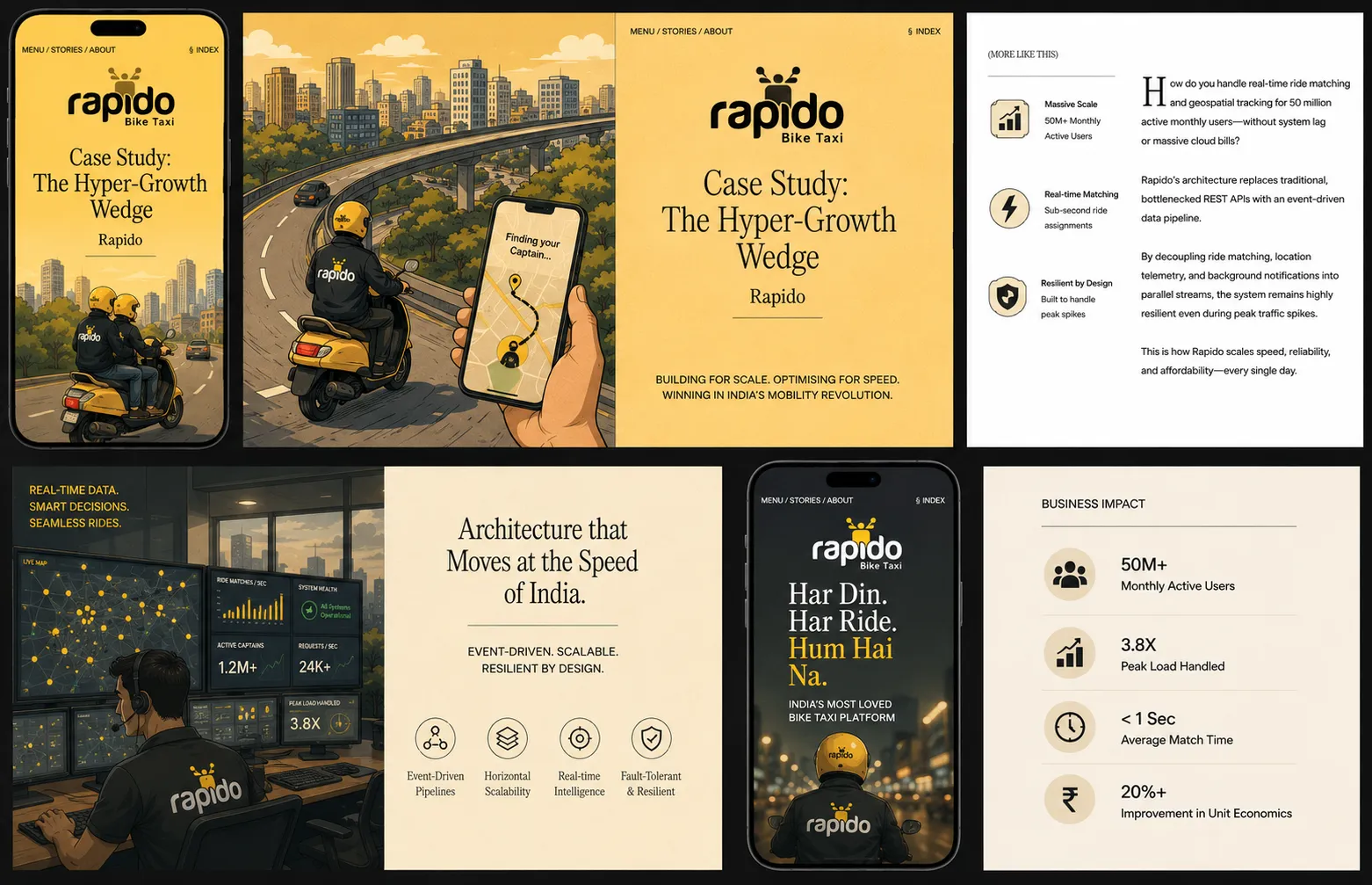
Rapido's Biggest Risk Isn't Competition. It's Distribution.
Introduction
Rapido's growth story is well documented.
It entered a market dominated by giants, focused on a customer everyone else overlooked, and built one of India's largest mobility platforms in less than a decade.
The more interesting question isn't how Rapido won.
It's what happens once a company reaches this scale and discovers that the one channel it depends on the app stores is outside its control.
That isn't a hypothetical scenario anymore.
It's already happened.
At a Glance
Before diving into the technical teardown, here's a quick overview of Rapido's business model, the biggest operational risks, and why they matter. While Rapido has successfully built one of India's fastest-growing mobility platforms, the company's dependence on native app distribution introduces risks that become visible only at scale.
The Business
Rapido disrupted India's ride-hailing market by focusing on a segment that Ola and Uber largely ignored: bike taxis for short-distance urban commuting. Instead of competing directly for premium cab users, the company built an efficient marketplace around India's existing two-wheeler ecosystem before expanding into autos, cabs, logistics, and food delivery through Ownly.
The Hidden Risk
The biggest strategic risk isn't competition, it's distribution dependency.
Rapido's consumer experience is almost entirely tied to native mobile applications. During the Maharashtra bike taxi dispute, reports suggested regulators asked Google and Apple to remove ride-hailing apps from their stores.
If app distribution becomes unavailable in a region, Rapido currently has no meaningful consumer fallback such as:
- Mobile web booking
- Progressive Web App (PWA)
- WhatsApp ride requests
- SMS booking flow
That makes the App Store and Google Play Store a critical single point of failure.
The Operational Gap
Rapido has also faced regulatory scrutiny over advertising guarantees like "Auto in 5 minutes or ₹50 back."
From an engineering perspective, this isn't simply a marketing problem.
Every public guarantee becomes an operational commitment that should be continuously validated using production metrics. Without real-time monitoring, customer promises quickly become regulatory exposure.
Infrastructure Opportunity
Public technology signals suggest Rapido already operates a modern DevOps stack including CI/CD pipelines, monitoring, and cloud infrastructure.
If those signals are accurate, the improvements discussed throughout this analysis don't require rebuilding the platform.
Instead, they involve introducing additional validation, monitoring, and resilience checks inside systems the engineering team likely already uses.
The Business Strategy That Worked
Rapido didn't beat Uber and Ola by building a better cab service.
Instead, it identified an underserved customer segment: commuters travelling four to seven kilometres through congested Indian cities where booking a car felt expensive, slow, and unnecessary.
India already had the supply millions of privately owned two-wheelers. Rapido simply organized that supply into a scalable marketplace, allowing riders to move faster through traffic while keeping operating costs significantly lower than traditional ride-hailing platforms.
Building a Market Instead of Fighting One
Rather than competing head-to-head with incumbents, Rapido created a category they weren't aggressively defending.
Its strategy focused on three structural advantages:
- Lower trip pricing
- Faster travel during traffic congestion
- Better economics for short-distance rides
Once bike taxis achieved scale, the company expanded into adjacent verticals including autos, cabs, logistics, and food delivery.
Reusing the Captain Network
One of Rapido's strongest strategic decisions was launching Ownly without building an entirely new delivery fleet.
Instead, the company reused its existing Captain network.
This creates multiple advantages:
- Better driver utilization
- Lower acquisition costs
- Higher earning opportunities for Captains
- Improved marketplace efficiency
It's a playbook similar to Uber Eats and GrabFood, where the same supply network powers multiple businesses throughout the day.
Why the Website Feels Surprisingly Simple
For a company valued in the billions, Rapido's website appears unusually lightweight.
That's largely intentional.
Unlike SaaS businesses, ride-hailing platforms depend heavily on native mobile capabilities including GPS access, payment processing, background location tracking, notifications, and live ride monitoring.
Those experiences simply work better inside mobile applications than browsers.
Why the Website Exists
The consumer website primarily serves three purposes:
- Build brand trust
- Explain products and services
- Redirect visitors to mobile apps
Where the Website Does More
The business-facing experience tells a different story.
Merchant onboarding, delivery partnerships, and business enquiries are completed directly through the website because these workflows don't depend on native mobile functionality.
The split between consumer and business experiences is therefore intentional rather than accidental.
SEO & Website Observations
Although the overall strategy makes sense, several technical SEO improvements remain:
- Missing metadata on programmatic city pages
- Duplicate FAQ content
- Repetitive image alt text
- Inconsistent internal linking
- Weak optimization across location pages
These aren't strategic weaknesses, they're examples of operational debt that naturally accumulates as platforms scale.
The Bigger Problem: Distribution Dependency
This is where the technical story becomes significantly more interesting.
Reports from May 2026 suggested Maharashtra requested Google and Apple remove Rapido, Uber, and Ola from their respective app stores over unresolved bike taxi regulations.
Whether those requests ultimately succeed isn't the important question.
The important question is what that situation reveals about Rapido's architecture.
A Single Point of Failure
Today, nearly every customer interaction depends on two external platforms.
If those distribution channels become unavailable, Rapido currently has no meaningful fallback.
Missing capabilities include:
- Browser-based booking
- Progressive Web App
- WhatsApp booking
- SMS ride requests
- Offline booking workflow
This isn't simply a mobile app problem.
It's a business continuity risk created by distribution architecture.
When Marketing Becomes an Engineering Responsibility
Advertising guarantees often appear to be marketing decisions.
In reality, they're engineering commitments.
Statements like "Auto in 5 minutes or ₹50 back" imply measurable operational performance that should be backed by live production data.
Every customer promise should map directly to measurable system metrics.
Without continuous monitoring:
- Marketing moves faster than operations
- Compliance becomes difficult
- Regulatory exposure increases
- Customer trust erodes
The solution isn't weaker marketing copy.
It's stronger observability.
What the Infrastructure Already Suggests
Public technology trackers indicate Rapido likely operates a modern engineering platform built around:
- Go backend services
- Azure cloud infrastructure
- CircleCI deployment pipelines
- Prometheus monitoring
Technology trackers aren't always perfectly accurate, so these observations should be treated as directional rather than confirmed.
Assuming they're broadly correct, the required improvements are relatively small.
Instead of rebuilding infrastructure, Rapido could extend existing systems with:
- Build-time SEO validation
- Automated metadata checks
- SLA monitoring dashboards
- Alerting tied to marketing guarantees
- Emergency booking fallback flows
These investments are comparatively inexpensive while significantly improving operational resilience.
Where I'd Invest First
If I were prioritizing engineering improvements, my roadmap would focus on reducing business risk before adding new features.
1. Build a Distribution Fallback
Introduce a lightweight booking experience outside native applications.
Possible options include:
- Mobile web booking
- Progressive Web App
- WhatsApp ride requests
- SMS booking
The objective isn't feature parity.
It's ensuring app-store disruptions degrade the experience rather than eliminating an entire market.
2. Turn Public Claims into Live Metrics
Every customer-facing promise should map directly to production monitoring.
Engineering dashboards should continuously verify:
- Pickup times
- Success rates
- SLA compliance
- City-level performance
3. Move SEO Validation Into CI/CD
Every programmatic landing page should pass automated quality checks before deployment.
Pipeline validation should verify:
- Meta titles
- Meta descriptions
- Canonical tags
- Open Graph tags
- Structured data
- Alt text
4. Improve Content Quality
Finally, invest in long-term SEO improvements by:
- Removing duplicate FAQs
- Improving image alt text
- Expanding city-specific content
- Strengthening internal linking
- Enhancing programmatic landing pages
These aren't immediate growth levers, but they compound organic traffic over time.
Final Thoughts
Rapido's competitive advantage came from identifying an underserved market instead of competing directly with established players.
That strategy continues to work.
The next phase of growth, however, isn't about finding more customers, it's about reducing dependence on systems the company doesn't control.
As platforms mature, operational resilience becomes just as important as product-market fit.
The constraints eventually shift from competitors to regulators, infrastructure, platform policies, and public scrutiny.
Winning the market is one challenge.
Building a platform that continues operating when external systems stop cooperating is an entirely different one.
From Outdated to
High-Converting

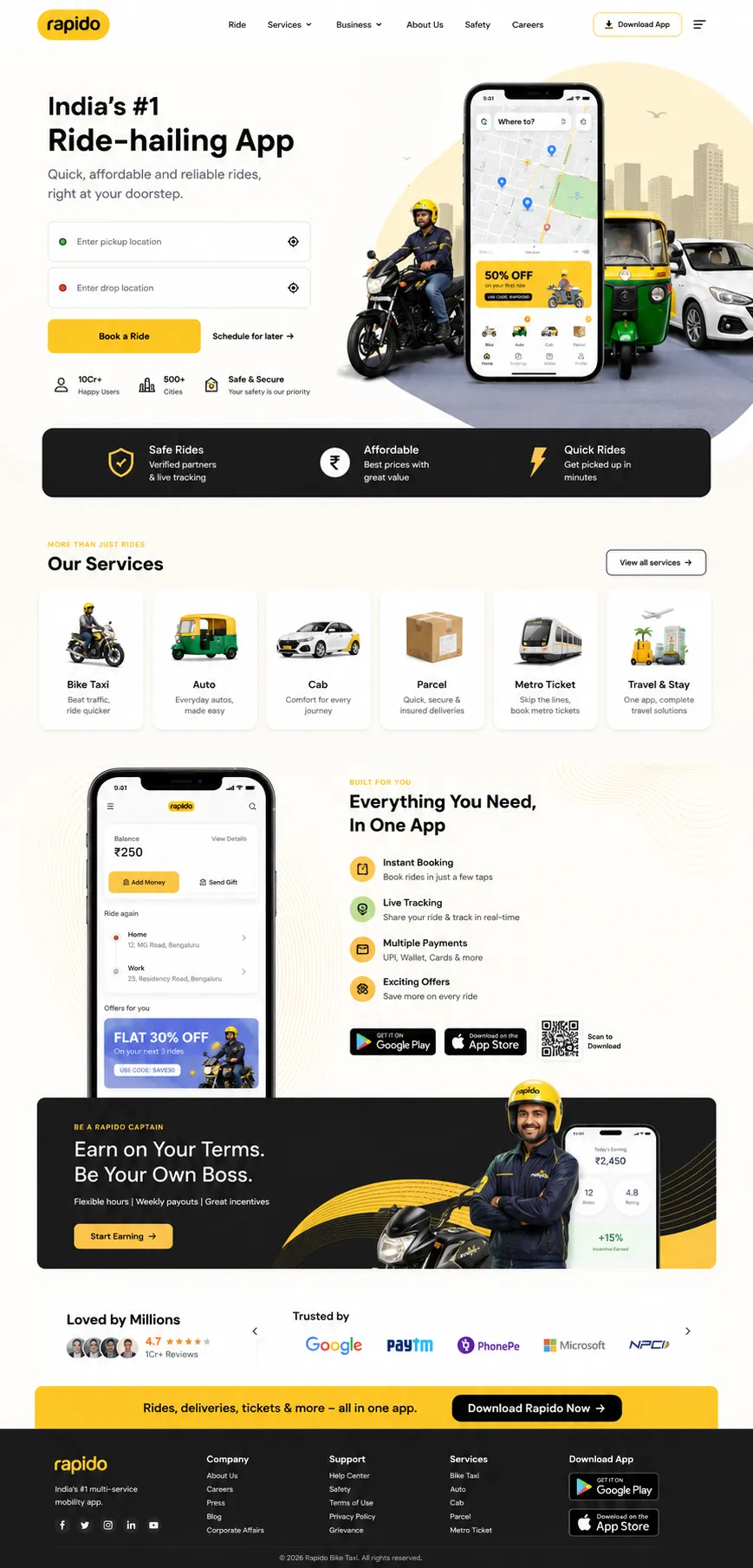
This project wasn't about changing colors, it was about rethinking how users experience the brand. Every screen was redesigned with clearer messaging, modern visuals, improved hierarchy, and conversion-focused layouts.
The redesigned homepage repositions Rapido as a complete mobility ecosystem rather than just a bike taxi service. A bold hero section with integrated ride booking, clean typography, and high-quality product visuals immediately communicates the platform's core value.
As users scroll, the page introduces individual services through intuitive cards, highlights key app features with supporting mockups, and reinforces trust using customer statistics, safety messaging, and recognizable partner logos. Every section follows a clear visual hierarchy, making the experience easier to navigate while naturally guiding users toward downloading the app.
What Changed
- ✓ Modern visual identity
- ✓ Better information hierarchy
- ✓ Faster page load performance
- ✓ Mobile-first responsive layouts
- ✓ Improved accessibility
- ✓ Stronger CTAs
- ✓ Better SEO foundation





Insights on design, strategy & web development






The Quick Answers
Still curious? Let's talk.
Whether it's a project, opportunity, or just an interesting idea, I'm always open to good conversations.